Environment
 Materiarity
Climate change measures
Materiarity
Climate change measures
Environmental Policy
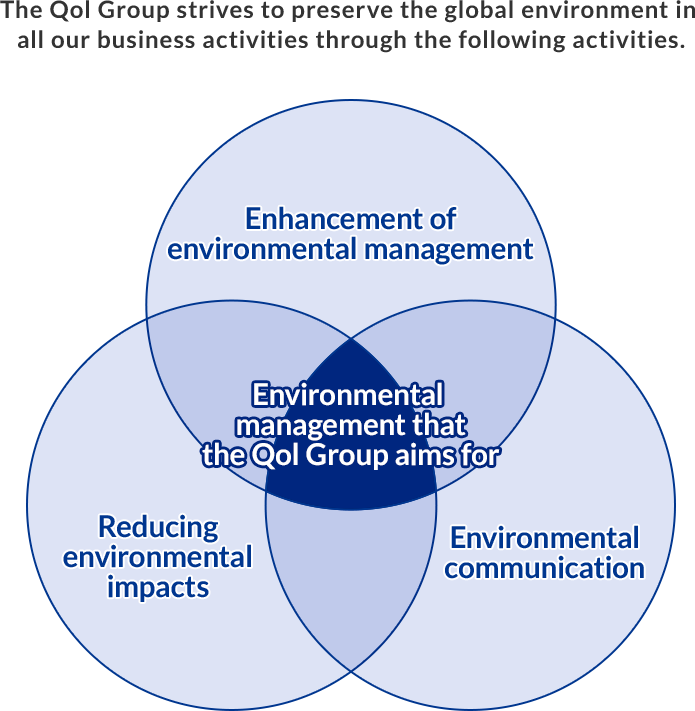
Enhancement of environmental management
We will care for ecosystems, reuse resources and energy, and strive to manage waste thoroughly.
- Thorough management of medical waste
- Responding to the Industrial Safety and Health Act
- Resource recycling (enforcing use of recycled toner)
Reducing environmental impacts
We are concentrating on promoting stores (hardware) with designs that do not place a burden on the environment, energy conservation, and CO2 reduction facilities and equipment.
Environmental communication
We will strive to cooperate with local communities and improve our employees' awareness of environmental conservation.
Climate change measures
Disclosure based on TCFD
The Group announced its support for the recommendations of Task Force on Climate Related Financial Information Disclosure (TCFD) in December 2022. In line with the TCFD’s goal of ensuring that companies and organizations appropriately disclose information on the risks and opportunities associated with climate change so that investors can make appropriate assessments, the Group is committed to appropriate disclosure according to the TCFD’s framework, and to working toward the goal of a sustainable society and economy. The four frameworks recommended by the TCFD recommendations (governance, risk management, strategy, and metrics & targets) are as follows.
Governance
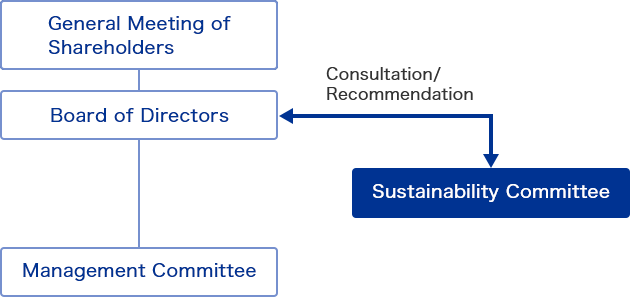
In order to contribute to the realization of a sustainable society through its business activities, the Group has established a Sustainability Committee, chaired by the President and Representative Director. The Sustainability Committee discusses matters related to sustainability and reports its findings to the Board of Directors. The Board of Directors makes decisions on important matters reported by the Sustainability Committee and supervises the committee.
In addition, we have established the Sustainability Committee Secretariat whose members consist mainly of the heads of relevant divisions of the Group, as a subordinate organization of the committee. The Sustainability Committee Secretariat submits proposals to the Sustainability Committee after deliberation and consideration of measures and KPIs to be implemented by the entire Group. It also manages the progress of measures decided by the Sustainability Committee.
Risk management
At the Group, for risks relating to overall business identified company-wide, the level of importance is identified based on factors including the degree of impact on management and likelihood of occurrence, and the Sustainability Committee manages matters to be addressed by the Group. It also reports the contents of these matters to the Board of Directors as appropriate.
Strategies
(i) Identification of significant risks and opportunities
Risks associated with climate change can be categorized into those resulting from the transition to a low-carbon society (transition risk) and those resulting from changes in weather patterns, such as more severe weather disasters (physical risk). Moreover, climate change can be viewed not only as a risk but also as an opportunity due to changes in patient behavior. The following are risks and opportunities associated with climate change that the Group considers to have a significant impact. We will review and carefully examine risks and opportunities as appropriate.
(ii) Scenario analysis
Using the scenario analysis method, the Group has begun analyzing the impact on its business activities of all dispensing pharmacies and convenience stores and shops in the Pharmacy Business, and Fujinaga Pharm Co., Ltd. in the Medical-Related Business.
This analysis is conducted in accordance with multiple scenarios drawn up by the IPCC (Intergovernmental Panel on ClimateChange), IEA (International Energy Agency), and other organizations.
As mentioned earlier, we have organized the risks and opportunities based on the TCFD recommendations and external reports. The secretariat is currently leading the discussion to incorporate various opinions.
We also analyze the impact of each scenario and worldview on financial and business strategies, etc., not only negatively, but also expanding to positive impacts.
Target
businesses |
Pharmacy Business |
Dispensing pharmacies, convenience stores and shops |
Pharmaceutical
Manufacturing Business |
Fujinaga Pharm Co., Ltd. |
| Scenario |
Transition scenario |
IEA WEO2019 |
| Physical scenario |
IPCC AR5 |
| Target period |
2030, 2050 |
Metrics & targets
See “Decarbonization initiatives” below.
Decarbonization initiatives
Certification obtained from SBTi, an international climate change initiative
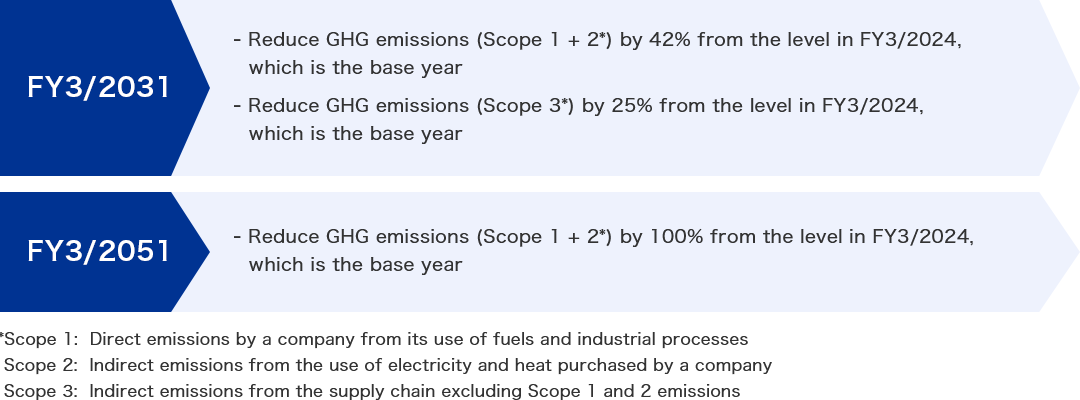
To further accelerate our decarbonization initiatives, we have set new greenhouse gas (GHG) emission reduction targets. These new targets have been deemed to conform to the Paris Agreement, and we have obtained Science Based Target initiative (SBTi) certification. We will continue to further strengthen our initiatives to address social issues in a group-wide manner in collaboration with various stakeholders, thus helping build a sustainable society.
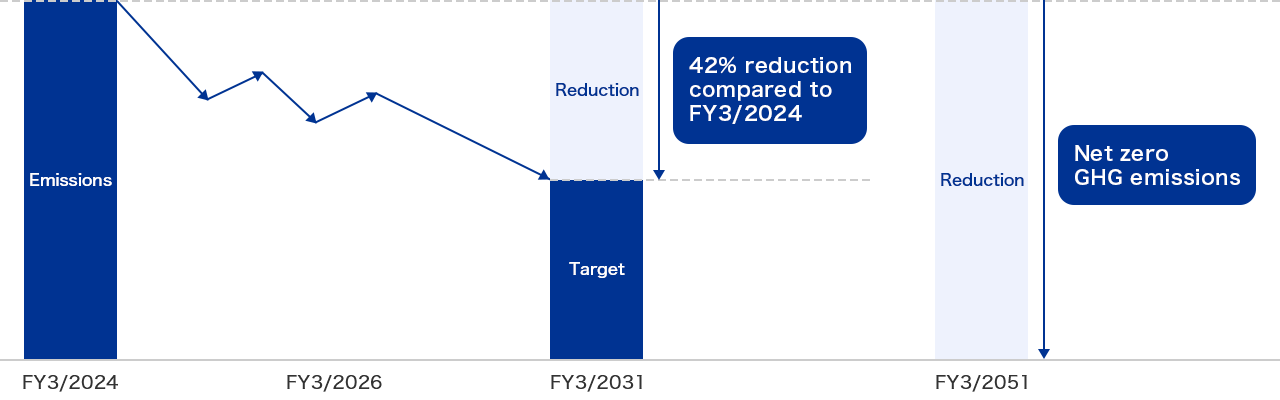
GHG emission reduction targets
Scope 1+2 reduction image
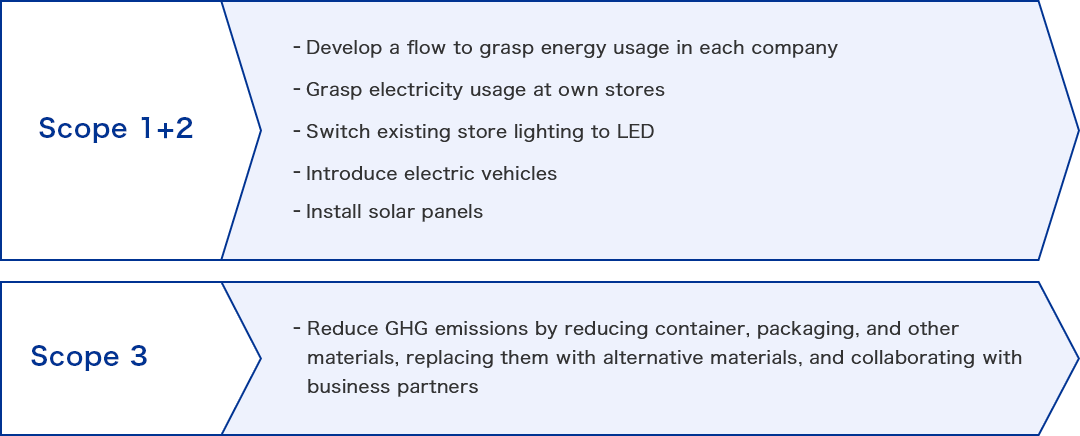
Main measures
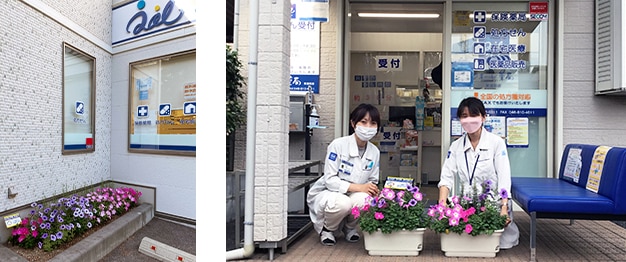
Group-wide Greening campaign "Green Smile Project"
Qol Group is working on a greening campaign called "Green Smile Project."
Nationwide pharmacies are planting flowers and installing ornamental foliage plant in order to create a pharmacy that is comfortable for patients, contribute to environmental conservation and promote company-wide understanding of SDGs.
To embody "mutually supportive" and "gentle" within the Corporate Slogan "Always there to care.", we are moving forward to become an "environmental- and patient-friendly pharmacy" through the campaign.
Reducing environmental impacts through business activities
- Qol Co., Ltd. / Group dispensing pharmacies
Model stores with CO2 reduction and environmentally friendly facilities
The Qol Group strives for global environment conservation by reducing environmental impacts in all of its business activities. At pharmacies, we focus on store design that does not place a burden on the environment or stores with good energy-saving performance and CO2 reduction facilities. Examples include solar panels on rooftops and highly energy-saving LED lighting.
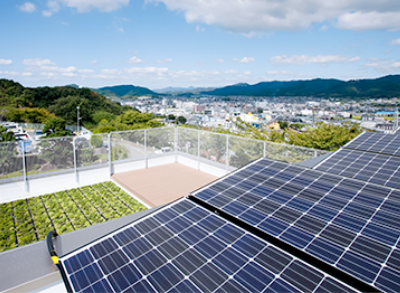 Solar Panels on roof
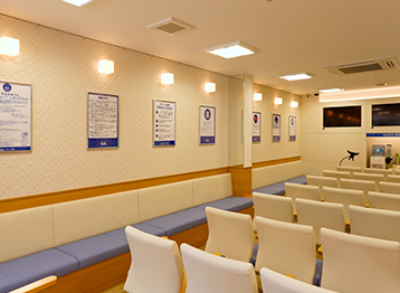 Energy-saving LED lighting
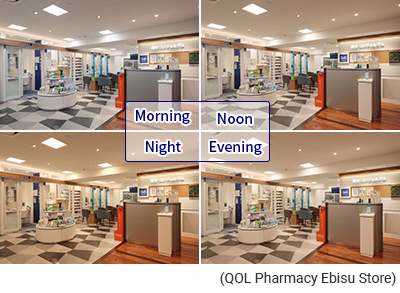 Change lighting by time of day
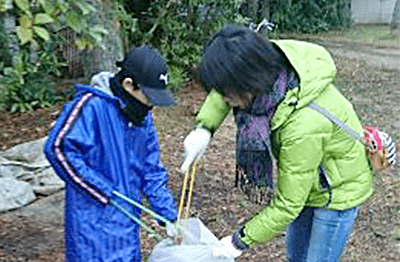
Environmental volunteering activities
- Qol Co., Ltd. / Group dispensing pharmacies
While making efforts to increase our involvement in local communities, we are committed to raising environmental conservation awareness of each employee within the Group.
- Environment beautification volunteering activities (beautification and cleaning of the surroundings of the pharmacies)
- Promote Cool Biz and Warm Biz (wearing cooler clothing during summer and warmer clothing during winter to save energy and reduce CO2 emissions)
- Activities for going paperless (Qol)
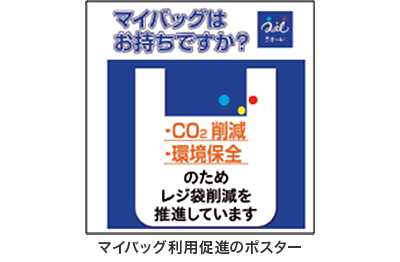
Promoting use of reusable shopping bags and eco-friendly plastic bags
- Qol Co., Ltd. / Group dispensing pharmacies
All stores of the Qol Pharmacy Group are running the Bring Your Own Bag Campaign to reduce the use of plastic bags. When plastic bags are necessary, we use eco-friendly plastic bags containing 30% plant-derived biomass materials.